
 Short-span bridges may be small, but their closures can have outsized impacts. These structures often carry emergency vehicles, school buses, agricultural traffic, and daily commuters, especially in rural areas where detour options are limited.
National Bridge Inventory data shows that more than 36% of U.S. bridges need repair or replacement, and nearly half are over 50 years old. Short-span bridges account for over 70% of the national inventory, with a large share of structurally deficient bridges located in rural communities.
When a short-span bridge is closed, the disruption is rarely proportional to its size. FHWA data indicates that detours, fuel use, and travel time delays can cost thousands of dollars per day for each closure.
In Lancaster County, South Carolina, a wooden-beam bridge was closed after an inspection revealed a shattered support beam. The closure led to:
- About 5,800 vehicles per day being rerouted
- An eight-month closure
- Delays for school buses and ambulances
Despite the bridge’s short span, the length of the closure created significant impacts. This is a common pattern in bridge replacement: closure duration is often dictated by construction logistics, not engineering complexity.
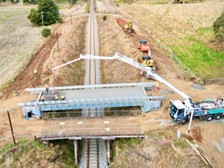 Why replacement schedules stretch out
For many bridges, extended timelines are not caused by unusual design requirements. Instead, schedules are shaped by how the project is delivered. Traditional approaches often involve:
- Separate workflows for design, fabrication, and construction
- Extensive on-site formwork and temporary works
- Multiple trades working sequentially
Each step adds coordination and increases the risk of delay, particularly in rural areas with limited contractor availability.
 A delivery-focused way to shorten bridge closures
Because schedule challenges are closely tied to field complexity, some agencies are evaluating delivery approaches that reduce the amount of work performed on site.
Unified delivery is one approach. It keeps standard reinforced-concrete design practices in place but integrates design, fabrication, and assembly into one unified system. Structural components are prefabricated and then cast in place on site, reducing the number of independent construction steps.
Documented projects using this approach show:
• Up to 60% fewer on-site labor hours
• Installation windows measured in days rather than months
• Less reliance on falsework, dewatering, and extended staging
For agencies focused on minimizing closure duration and detour impacts, delivery method selection plays a meaningful role.
Download our full eBook for a deeper look at how modern delivery methods are improving short-span bridge replacement timelines and minimizing negative community impact.